- 1994 the original found family sold to Investcorp.
- 1999 LVMH buys Ebel
- 2003 Movado buys Ebel from LVMH for, I believe, $62.2 million yankee greenbacks - this also included Le Courbusier's La Villa Turque, a house I have walked past more times than I have fingers and toes.
- 2026 Movado goes on the block again and this time is picked up by a consortium which includes Chanel and F.P. Journe (among others) who will control 95%, with the price being $66.5 million, meaning that the part retained by Movado is valued at $3.325 million, meaning a total value of just south of $70 million ($69 and some change) if my math is right. The big question is - who gets to live in the house ; )
Saturday, October 10, 2026
Weird Wild Stuff...
Saturday, March 14, 2026
The Transfer Window Opens (for the FOURTH TIME IN TWO YEARS)
![]() |
| Courtesy of Tag Heuer |
In the interest of transparency, I have about as much interest in the machinations of Tag Heuer and the LVMH watch stable writ-large as I do in hemorrhoid treatment. Actually, that's not fair. If and when I do develop hemorrhoids I suspect I will have more than a passing interest in the healing properties of Preparation H. But as they say, sometimes you have to lance a boil, and as this is outlet that talks about watches (allegedly), I guess we have to give "mighty Tag Heuer" some air time.
Okay, let's get to the heart of this. I have no doubt that the new person in the hot seat is probably more experienced and capable than the winners of the Arnault Family DNA Olympics. And add to that, Ms. Goasglas has been with Tag Heuer since 2018, and held some pretty big jobs with them. And it doesn't hurt that she is French, because although HQ is in La Chaux-de- Fonds, the real marching orders are coming from an arrondissement several train stops North by Northeast.
The timing is a wee bit quirky as well, why hold off for May 1? There is a little event that some people say is even more prestigious that The HYPE NYC ; )
The real question is this - what the f&*k has been going on at Tag Heuer and LVMH's watch division? Hublot has become an afterthought, and Zenith is starting to operate from the Sunk Cost Trap theory of business -
https://www.henkitime.com/2017/04/the-sunk-cost-trap.html
So what I'm driving at is this: for all his faults - and he has more than his share, the LVMH watch brands (Hublot, Tag, and Zenith) under Jean-Claude Biver's oversight at least seemed to know what they were doing. Or in Zenith's case what they were trying to do.
Regardless of the heroes and zeroes of the (recent) past, we at Henki Time wish Ms. Goasglas bon chance and Godspeed.
Tag Heuer may just be a dog that won't hunt, but we shall see.
Sunday, January 25, 2026
Baumes Away!
Friday, November 22, 2024
Reheated Leftovers - The Sunk Cost Trap
The Sunk Cost Trap
Why?
Well, because we feel that we have "SUNK" too much time, and or money into the exercise and we further feel that all of that time and money will be wasted if we changed course.
Sound familiar?
The Sunk Cost Trap explains why we keep books that we'll never read, and clothes that we've never worn.
The Sunk Cost Trap explains why some brands continue to "sink" hundreds of thousands of dollars into failing partnerships, celebrity ambassadors and the on again, off again retention of the same PR firm that tends to get signed for a year, then replaced the next year, only to be signed again the year after that. It's a bit like the Olympics or the World Cup, except that it's every two years instead of four.
The Sunk Cost Trap explains why blogs and magazines will continue to keep a brand's ads running even though the brand has not paid for an extended period of time. This is two-fold:
2. Fear that walking away will ensure that the brand will never advertise with them again - which is pretty silly when you consider that they are giving the brand free advertising already and not getting paid. What exactly is it that they are afraid of losing?
The Sunk Cost Trap explains why someone who really only wants one nice watch will buy several discounted through the grey market assuming and hoping that the value of those watches will somehow magically increase in the not-too-long term so that they will be able to flip those watches and have a nice enough profit to then afford that one nice one...
The Sunk Cost Trap explains why a retailer who continually hoses the brand manager by not paying their memo account when they actually sell something will not be confronted by the brand manager.
The Sunk Cost Trap explains why an honest retail partner will get shafted by a brand who will not provide them with a limited edition watch to sell to their client (at full price) because they want to try to sell it at their own boutique. Even though they do not have anyone who wants to buy it. But the fear of having had it, and not selling it?
You get the idea.
Saturday, August 17, 2024
Meanwhile...Back At Hodinkee...
![]() |
| Fine Art Images/Heritage Images/Getty Images & AFP/Getty Images |
Now back to the matter at hand - if, indeed, Mr. Fowler has left Hodinkee, it makes a certain amount of sense as his background is not media, it is retail. And seeing as (at least this week) retail is off the table at Hodinkee, then it might be time to refocus and seek out senior leadership that might better fit the new approach.
Tuesday, December 29, 2020
Winders - Hyperbole, Hype, and Shitting the Bed
So a now familiar scene here at Tempus Fugit HQ - order new winder, winder arrives and doesn't work, you search for any sort of info that will address the issue. The "winder company" doesn't bother to explain one key piece of information in either its sales materials (online store) or put any info along the lines of a "getting started" document that might ship with the winder. So you essentially have to figure it out for yourself - apparently the winder must be plugged in overnight before it will work (it is meant to be able to run either by plugging in or using battery power). Long story short, after an overnight the winder worked wonderfully.
A few months later, it was still working by battery charge, but starting to make a wobbly noise that was a bit disconcerting. Fast forward a little bit further, and now the winder will not work at all unless plugged in, and it makes a ratcheting noise that gives the feeling the watch might fall out of the winder at any moment. Oh, and then after one series of winds? It powers off.
Now a few important points - in fairness, the winder cost a very affordable sub $50 US (discounted from approximately double that). So I viewed it as a safe gamble and an affordable way to get a winder and write an unbiased product review. In hindsight, the customer service was a bit iffy (read nearly non existent), and the winder itself crapped out after less than 6 months. Simply put, as cynical as I can be, it seems unfair to air out the details about who made the winder, who sold it and all the low points (along with 1 or 2 positives). It is too easy a target and won't really address what might be the bigger picture.
By and large, very few companies that sell watch winders actually make watch winders. Now this is not to say that is a universal truth, but it is pretty accurate. Essentially, the winder company is often in a roll not unlike a drop ship fulfillment program. The winder itself is more often than not an off the shelf (not that there is anything wrong with that) item that is then embossed with the selling company's name and packaged in their livery, then shipped.
And it goes a bit further, these are often "full solution" deals where the winders are packed with (or often without) instructions, etc. in a sealed shipping box. The seller then simply stacks the boxes, and then forwards them to the buyer. And in fairness? As the first customer (of the winder manufacturer) they should reasonably expect that things will work as advertised. The final customer then orders, the "winder company" pulls a box and ships it.
Now let's get into the wonderful reality that is the "Sunk Cost Trap" - as it applies to your old pal, Henki -
Henki is a guy who worked at Tourneau, worked for DOXA, consults with a few brands here and there and likes to think he's been around the block a few times. Henki also knows, to a certain extent, where watches and watch accessories come from. When it comes to winders, the motors (i.e. everything electronic that actually winds the watch) comes from China. Nothing wrong with that. While Henki makes some decent coin in the watch game, he is a Northern Youth, and a full-time educational social worker at his core and prefers not to drop a shit-ton of money on pretty things to sit on his desk or dresser that, at their heart, are simply meant to perform a function - keep an automatic watch wound when not being worn. Henki understands that some more established and expensive brands (Underwood, Orbita and others) cost significantly more, have a more solid track record and tend to offer better customer support. But, again, Henki would like to think that he is savvy enough to know that the motors are, most likely, from the same source. And here is where Henki has learned a very valuable lesson about the difference between what is said and what, in fact, is.
Long story short - in terms of watch winders, it is now very clear to this guy that you get what you pay for. And now for one of the other glaring oddities about watch folks and how we prioritize our spending -
We have very little problem spending sometimes budget ruinous amounts of cash for YET ANOTHER WATCH, but balk at spending perhaps 3 times the amount of a bargain (read "soon to become useless motorized paper weight") winder on one that will actually work as advertised or be remedied by the company that sold it. It seems to be, if I am very honest, a ridiculous stumbling point. I'll put it another way - I am willing to presume that the difference between an Underwood or Orbita winder and the last few I've purchased is perhaps more than simply good marketing.
So the hunt is on now for a winder that will, I don't know, actually keep a watch wound for more than 6 months. So keep an eye on this outlet, as I am now on a mission - one I intend to report on rigorously.
Stay tuned!
Friday, July 5, 2019
Summer Repeat - The Sunk Cost Trap
It's been an interesting several months since BaselWorld. Although Swiss exports nudged themselves up a wee-bit during May, it is getting pretty clear that a return to the amazing results of the early 2000s are not coming back anytime soon. Curious to relate, I spoke with a brand owner who had been visiting the EPHJ this past June, and word around the campfire was not particularly hopeful. Consider that for a moment, these are people who make their money on being hopeful, convincing brands and watch makers to purchase the latest tools and supplies. When these folks are pessimistic, it tells you that there may be a longer recovery ahead, and the other thing that it tells you? This might be as far as the industry is going to recover.
The Sunk Cost Trap
Why?
Well, because we feel that we have "SUNK" too much time, and or
Sound familiar?
The Sunk Cost Trap explains why we keep books that we'll never
The Sunk Cost Trap explains why some brands continue to "sink"
The Sunk Cost Trap explains why blogs and magazines will continue
1. Time spent and money not received
2. Fear that walking away will ensure that the brand will never
The Sunk Cost Trap explains why someone who really only wants
The Sunk Cost Trap explains why a retailer who continually hoses
The Sunk Cost Trap explains why an honest retail partner will get
You get the idea.
Friday, February 1, 2019
The Funny Thing About Numbers
One person's success is another person's cause for concern.
Let's start with the big picture with the December results from the FH -
![]() |
| Courtesy of the FH |
Talk to most retail partners and you do not exactly hear how good things are. The big swinging dicks (i.e. the decision makers for several BIG retail sources) took a pass on SIHH. Let that sink in. Now consider that BaselWorld is going to continue to compress and a lot of retailers will give it a miss as well. No, this does not mean that we are entering "end times", it does mean that this recovery is not exactly what some outlets would have you believe.
So who is doing well right now? The grey market. When big brands are offloading directly to the grey market sources, that ensures a steady (albeit much smaller than hoped-for) outflow of watches from the 26 Cantons. It also means that the price for "almost new' watches offered by your favorite online resources will continue to move downwards as supply will continue to outstrip demand. Yes, I did retain that much from my failed class back in 1988. Which means that more and more people will find themselves unwilling to pony-up the full sticker price to buy from an actual retail partner.
So let's think about a few basic facts -
1. With the new Swiss regulations, there are likely to be fewer exports in the coming months as several brands are trying to "toe the line" on the rules. Important side note, several brands can't be asked to comply and are still playing it fast and loose, so we shall wait and see what potential repercussions might be.
2. The grey market isn't going anywhere, but just as Las Vegas and Times Square shed their lurid pasts, the grey market is now squeaky clean and presenting itself as a trusted source for previously owned watches. A little inside baseball, what that really means is that the watch is being sold as pre-owned, but it is likely the most wear it ever saw was in a store where it didn't sell. And again, there is nothing wrong with this, but it is not good in the long run for the brands. And for you the buyer? You're all excited about getting that "Like New in Box" watch for 40% off - until you decide you want to trade or sell it. And then you come face to face with our old friend, the sunk cost trap. And that goes double for the brand directors driving their products straight into the grey market hopper.
3. Retail will not totally disappear, but we will see more retail stores go under. Sorry, there is no way around it.
4. Ditto for watch brands.
So here's hoping I am wrong, that all is well, sales are brisk, and the needle will tick up again.
Sunday, December 23, 2018
We Sail Tonight For Singapore - Part the Third
We sail tonight for Singapore
Take your blankets from the floor
Wash your mouth out by the door
The whole town is made of iron ore
Every witness turns to steam
They all become Italian dreams
Fill your pockets up with earth
Get yourself a dollar’s worth
Away boys, away boys, heave away
So the November numbers are in, and because it appears to be my lot in life to be (if not the lone) one of the few contrarians out there in the watch world, here goes -
![]() |
| Courtesy of the FH |
The first thing to notice is that the numbers are going rather retro. Now in fairness, they are much better than this time last year. But if we are looking at them objectively, it is safe to say that they have been slipping the last 3 months. And it is also safe to say that the only reason that they are as good as they are, is the push to shove as much product across the borders of the various cantons before the new regulations go into force.
But then it gets more interesting when you factor in the countries that are "up" versus "not-so-up".
Curious to relate?
Mighty Singapore is once again back with one of their semi-annual market surges this time of (wait for it) +9.5%.
Now in the interest of total transparency, the closest I have ever come to Singapore was when my girlfriend (at the time) left Japan to return home to the UK and spent a week in Singapore and sent me postcards and letters from the Raffles Hotel in, you guessed it, Singapore. Well, needless to say that relationship did not stand the test of time, nor do I suspect that the recent (again, semi-annual surge) of watch exports to Singapore, truly signals their emergence as a world hub for buying watches. Now as a source to "source" grey market watches for global "discharge"? Sure!
Even stranger, the US is apparently the darling of the industry with a mighty surge of + 17.6%. Curious to relate (again) this export figure does not nearly match the (granted anecdotal) evidence provided by several US retailers that I have spoken with. Of those I have spoken with? Sales are pretty flat.
Once again, at the risk of being, well, honest? If the export numbers don't correlate with the "on the ground" feedback about actual sales, it tells you one clear thing that further informs other points -
1. Watches are being exported to subsidiary offices to get them off the books at Swiss HQ.
2. Watch sales are flat in North America.
3. The grey market has PLENTY of product to sell.
The industry has not recovered. Sorry, but it hasn't. On the positive side? Several brands have reduced their production to match real world demand. The problem? There was way too much product sloshing around that had to be flushed through the system. And short of crushing watches? That means our old friend the grey market. The good news? Lot's of affordable (let's call them price adjusted to reality) watches will now be available! And hey, don't worry about the warranty! You'll get some chicken-shit after market warranty for your pennies on the dollar purchase.
It is a tired, skipped record from this d-jay, but simply put. If you buy a grey market watch at a bargain price? Don't lose your shit when that watch is worth even less than you paid for it when you are hoping to re-sell it. Along with the grey market? The Sunk Cost Trap is alive an well!
Enjoy your watches, and spend your money carefully!
Friday, May 4, 2018
Repeat - The Sunk Cost Trap
What Barry Hearn Could Teach the Watch Industry - 3
Which brings us back to today's repeat:
The Sunk Cost Trap
Why?
Well, because we feel that we have "SUNK" too much time, and or money into the exercise and we further feel that all of that time and money will be wasted if we changed course.
Sound familiar?
The Sunk Cost Trap explains why we keep books that we'll never read, and clothes that we've never worn.
The Sunk Cost Trap explains why some brands continue to "sink" hundreds of thousands of dollars into failing partnerships, celebrity ambassadors and the on again, off again retention of the same PR firm that tends to get signed for a year, then replaced the next year, only to be signed again the year after that. It's a bit like the Olympics or the World Cup, except that it's every two years instead of four. Why? Because they've sunk too much money into it now to walk away.
The Sunk Cost Trap explains why blogs and magazines will continue to keep a brand's ads running even though the brand has not paid for an extended period of time. This is two-fold:
1. Time spent and money not received
2. Fear that walking away will ensure that the brand will never advertise with them again - which is pretty silly when you consider that they are giving the brand free advertising already and not getting paid. What exactly is it that they are afraid of losing?
The Sunk Cost Trap explains why someone who really only wants one nice watch will buy several discounted through the grey market assuming and hoping that the value of those watches will somehow magically increase in the not-too-long term so that they will be able to flip those watches and have a nice enough profit to then afford that one nice one. Which never happens because - you guessed it - they are then trapped by the notion that if they sell the watches they bought on the grey market they will be losing money. Which, of course, they will. So they hang onto the not-so-loved watches in the hope that things will change.
The Sunk Cost Trap explains why a retailer who continually hoses the brand manager by not paying their memo account when they actually sell something will not be confronted by the brand manager. The brand manager has sunk too much time and too much money into the partnership, and even though they often wait a ridiculously long period of time to get paid (making several expensive trips to the retailer to count the safe and prove to them that, in fact, they have sold the watches and need to pay), this "partnership" will live on. Often without the brand manager getting paid, and inevitably seeking new professional opportunities.
The Sunk Cost Trap explains why an honest retail partner will get shafted by a brand who will not provide them with a limited edition watch to sell to their client (at full price) because they want to try to sell it at their own boutique. Even though they do not have anyone who wants to buy it. But the fear of having had it, and not selling it?
You get the idea.
Thursday, April 27, 2017
March...
![]() |
| Courtesy of the FH |
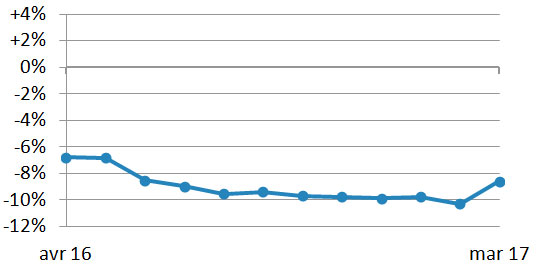
The March numbers are in, and as noted by the FH they seem to be a bit better. But interesting to relate that the FH has taken to tempering their feedback of late, stating essentially that although this is an improvement, don't read too much into it.
But there are a few other indicators out there that might shed a wee bit of sunshine. Per some reports, the total number of retail store closures in North America has been down this first quarter. And that is a potentially positive development as well. But these same outlets also report that the number of NEW North American retail stores is also down.
Obviously, it is in the best interest of everyone involved if the industry rebounds. But this has been a beat-down of nearly epic proportions for brands, distributors, retailers and yes, even customers. A beat-down the likes of which we haven't seen since the "Quartz Crisis". And while there were real lessons learned from that paradigm shift, it remains to be seen if this current paradigm shift will illicit the same level of introspection at the higher echelons.
And while the rate of decline is slowing, it does not necessarily mean that we are in blue sky territory. What it most likely means is that the rubber has finally hit the road and at least some of the brands, distributors and retail store owners are starting to realize that things are most likely not going to rebound back to the level that they were. Production, sales forecasts and pricing might finally be getting closer scrutiny. The perceived need to carry such large staffs both in Switzerland and in the "outposts" might be getting a second look as well.
And we have anecdotal evidence that clearly shows that brands and those dependent upon those brands are starting to change their attitudes and approaches. Some for sound business reasons, some just out of panic:
BaselWorld - will be reduced by 2 full days with participation fees (reportedly) to be reduced to reflect this change. With attendance down again for retailers and journalists, this was most likely a very cold cup of espresso for the BaselWorld organizers to swallow, but the numbers just don't lie. It was a bold decision to take, and one that I agree with.
SIHH - 'nuff said.
Brand Managers - several found themselves let go just before and just after BaselWorld. This is not exactly a new development, but the level and depth of these cuts was a little more marked this year. So brands are going to be REALLY looking at who is performing and who isn't. Tough love time.
The "Soft Grey" Market - well known brands are clearly not selling at the level that the could or should, and growing portions of their stocks are being dumped into group buy sites. Merchandise has to be moved, and this seems to be the most acceptable of a lot of really unacceptable solutions.
And then, as always, there will be holdouts:
The Brand Boutique - for a few independent brands, there is still a monumental disconnect on the realities of their given situations and they continue to insist on dropping more and more money into a boutique that can never really pay for itself. For a group brand? No big deal, it is a marketing expense. For an independent brand? It is an ego stroke and a fairly clear disregard for reality. And it also reflects the Sunk Cost Fallacy (please refer back to the Sunk Cost Trap - http://www.tempusfugit.watch/2017/04/the-sunk-cost-trap.html for further examples) that is at work at the highest levels of some of these brands. When you have sunk as much money as some independents have into these boutiques, it becomes harder and harder to walk away.
Now contrary to the frantic assertions of a certain watch industry writer, I am not the Antichrist. I truly take no satisfaction in seeing the industry suffer. But I also believe that just because you trim a donkey's ears, that doesn't suddenly give you a Shetland Pony.
Some of the industry is moving to adapt, and some particularly sharp operators have been a few steps ahead and have done okay even during this downturn. The real challenge now is for the remaining denizens of planet "Watch" to decide if they are ready to adapt or not.
Because while a reduced loss is better than an increased one, it is still a loss.
Monday, April 24, 2017
The Sunk Cost Trap
Why?
Well, because we feel that we have "SUNK" too much time, and or money into the exercise and we further feel that all of that time and money will be wasted if we changed course.
Sound familiar?
The Sunk Cost Trap explains why we keep books that we'll never read, and clothes that we've never worn.
The Sunk Cost Trap explains why some brands continue to "sink" hundreds of thousands of dollars into failing partnerships, celebrity ambassadors and the on again, off again retention of the same PR firm that tends to get signed for a year, then replaced the next year, only to be signed again the year after that. It's a bit like the Olympics or the World Cup, except that it's every two years instead of four. Why? Because they've sunk too much money into it now to walk away.
The Sunk Cost Trap explains why blogs and magazines will continue to keep a brand's ads running even though the brand has not paid for an extended period of time. This is two-fold:
1. Time spent and money not received
2. Fear that walking away will ensure that the brand will never advertise with them again - which is pretty silly when you consider that they are giving the brand free advertising already and not getting paid. What exactly is it that they are afraid of losing?
The Sunk Cost Trap explains why someone who really only wants one nice watch will buy several discounted through the grey market assuming and hoping that the value of those watches will somehow magically increase in the not-too-long term so that they will be able to flip those watches and have a nice enough profit to then afford that one nice one. Which never happens because - you guessed it - they are then trapped by the notion that if they sell the watches they bought on the grey market they will be losing money. Which, of course, they will. So they hang onto the not-so-loved watches in the hope that things will change.
The Sunk Cost Trap explains why a retailer who continually hoses the brand manager by not paying their memo account when they actually sell something will not be confronted by the brand manager. The brand manager has sunk too much time and too much money into the partnership, and even though they often wait a ridiculously long period of time to get paid (making several expensive trips to the retailer to count the safe and prove to them that, in fact, they have sold the watches and need to pay), this "partnership" will live on. Often without the brand manager getting paid, and inevitably seeking new professional opportunities.
The Sunk Cost Trap explains why an honest retail partner will get shafted by a brand who will not provide them with a limited edition watch to sell to their client (at full price) because they want to try to sell it at their own boutique. Even though they do not have anyone who wants to buy it. But the fear of having had it, and not selling it?
You get the idea.