Showing posts with label campagnolo. Show all posts

Saturday, July 8, 2023

Summer Repeat - A Few Minutes With Richard Sachs

As it is the first week of my favorite annual event - the Tour de France, it seemed like a good time to dust this one off and reheat it. Of all the interviews I've done, this is far and away one of my favorites!

And now a special summer repeat -


A Few Minutes With Richard Sachs

In the 12 years since this little project started, I have met a lot of people both inside and outside of the watch industry. There have been some pretty good interviews, and to be honest a few clangers. Well, gentle reader, I have to say that the following interview was one of the most interesting I have ever conducted. 

Regular insomniacs (readers) will know that I am more than a bit interested in cycling. And more to the point I have long been intrigued by the guys and gals who design and make custom bicycles. While there is no shortage of folks (recently) doing this, there is a dearth of talent at the very top. That's not a criticism of everyone else, but as with any pursuit, it is the rare individual who separates herself/himself by sheer force of will and talent. 

As a young man I fantasized about climbing with the peloton up the Tourmalet, and breaking away to win (for me) the most legendary stage in the Tour de France. (insert an image of me here - 50 pounds lighter, hands aloft and punching the sky as I rolled across the line). And in that daydream I was wearing the white with red polka-dot King of the Mountains jersey, and riding a Richard Sachs custom bicycle (with the Campagnolo Super Record Group - this was the 80s). Hailing from what is rumored to be one of the most topographically challenged (read flat) areas in the lower 48, my daydream remained just that. 

But the dream of riding one of the most desired frames in the world has never faded. For you non-cyclists out there, the best way to try and understand how long the wait list is for a Richard Sachs frame is to take the waitlist for a Rolex Daytona circa 2003 and multiply it by the list for a Patek Philippe Nautilus and then multiply that total by 100. And word around the campfire is that a frame by Richard Sachs is totally worth the wait.  

So without further ado, a few minutes with Richard Sachs -

Courtesy of Richard Sachs

James Henderson - What was your first watch?  Was it a gift?  Is there a story behind it?


Richard Sachs - The first timepiece I remember owning was a Hopalong Cassidy watch. I’m sure it was a gift during my early childhood. I loved it. And it’s funny - in reading the interview questions, I knew what my reply to this first one would be. 


It took me down a rabbit hole of memories. The watch came in a presentation case that opened from the top. That is, it was nesting inside and to find it you lifted the upper part of the box, and the base had the watch strapped around what was a horse saddle. The packaging art reeked of Wild West imagery. I loved the visual. And that everything was so secure owing to how ingeniously well the cardboard material was engineered. By itself it was a thing of beauty. I was never 100 percent comfortable (or happy) once I removed the watch and placed it around my wrist. For sure, it told time, but how important is this for an eight-year-old? What stuck was that I had to undo the strap, take the watch from the saddle, and then be left with this lovely box that no longer had purpose. I saved it, nonetheless. Thinking back, I’m sure this item and some others like it formed the basis of my love for - no, my infatuation with – fine design. I’m a former closeted follower of so many things presented well to whet consumer appetites. Now I’m out. I love love LOVE how products and their delivery systems can complement each other in their respective roles. I can get as much pleasure looking at objects wrapped for retail as I can using them. Wait. The presentation is often more rewarding. I’ll leave it there.


JH - If I understand it correctly, you were born and raised in New Jersey?  Can you share with us a bit about your youth?

RS - I’m from Bayonne. An only child raised by a single mom. Our street was red brick row houses, each two a mirror of those on either side. The city was diverse, and my childhood friends were a collection from all religions, backgrounds, ethnicities, and colors. I’m Jewish. I went to a Yeshiva some twenty miles away in Union City for my first through eighth grades. Bus rides in the morning. Bus rides in the late afternoons. My teachers were Rabbis. Once I realized I had a choice, I stopped caring about what they had to say or offer, learned to stare out the window, and waited to leave.


JH - So an honest (if sheepish) admission - as a Northern Youth growing up in Oberlin, Ohio in the late 70s and 80s, to quote The Wire - your name rang out. At that time, I was too young and too poor to buy one of your frames. Just prior to 50 it seemed the wait list might exceed my viable remaining cycling years (I am planning to keep going into my 70s), so I plumped for a custom Ciocc. So, apologies if this is a trite or tired question -

To what do you owe consistent popularity and success?

Courtesy of Richard Sachs
RS - About fifteen years ago, and in the middle of a forum thread about business practices, a peer asked me to distill my experiences into a single piece of advice. My reply included, “And never look up to see what anyone else is doing. No matter how wide the net is cast, all that matters is what you think. If you ever second-guess yourself, pause until you don’t.”


JH - I read a passage on your Instagram feed (IMPORTANT - FOLLOW this man on Instagram, you'll thank me!) about your most recent donation to your old school and I found your thoughts and reflections particularly evocative. As the director of an adult education program, I get my fair share of warm-fuzzies from former students, but this one took the biscuit. Would you mind sharing with us a bit about your alma mater and what the school meant to you then and means to you now?

RS - I went (read, I was sent) to The Peddie School because, for two years in my local public high school, I was a magnet for poor grades and any activities that could distract me from applying myself. I didn’t care about anything that happened in the classroom. I didn’t read. I neglected as many assignments as I could. I got by often by faking, or cheating on tests, or borrowing homework from pals. But on balance, I didn’t get by at all. My life as a freshman and sophomore consisted of me trying to have as much extracurricular fun as possible, legal, or not. What happened inside the school building never mattered.

Courtesy of The Peddie School
At Peddie, I boarded for three years. I repeated sophomore term because my grades coming in were beyond poor. Eventually, the small class sizes and with the help from one or two Masters (as teachers there were called), I came around. A Mr. Roberts (my English teacher and a Department Head) mandated that all Peddie boys had to keep daily journals. At first it wasn’t clear to me what purpose this served. We were encouraged to write. To write anything. But we had to write. Once each week we turned in our journals and the teachers graded them. To be clear, the grades weren’t applied to anything, but the margin comments gave us some idea of how we were doing with self-expression. 

The journal keeping, especially in my sophomore year, became a task I looked forward to nightly (that’s when we did our homework in the dorm rooms, doors always open, so the Masters could walk the hallways and make sure we were in there applying ourselves.)

Somehow, and as a result of all the contrasts between boarding school life and the one I knew from attending Bayonne High School, the writing thing got under my skin. I don’t want to dwell too far into the weeds, but at some point, in my first year at Peddie the school had a writing contest open to all grades. I submitted a short story entitled The Grass. By some streak of luck, and by some force of nature that to this day makes little sense to me, I won the contest. Me, little Richie Sachs from the old neighborhood. A sophomore for the second time. I penned over a thousand words that the English Department (whose Masters comprised the jury) thought my story was the best from among all 370 students. Fuck me. But the level of affirmation that came with this award put me on another path. And I still had another two years after this before I’d leave school.


The ordeal, especially being singled out, was a leaping off point for all that followed. Mr. Roberts was proud of me. My mom was proud of me. And, of course, it’s obvious I too was proud. But I never went to college. My Peddie School years, all three of them, were my higher education. 

Baby steps. But enough of them strung together are why my experiences at, and allegiances with, this school are so deep and wide.


JH - If you could make a Richard Sachs frame for any notable cyclist of the past, who would you build one for?


RS - I never know or ask what my clients do, or who they are. Some do tell me though.


JH - I apologize if this question sounds like it's coming from a rube, but it seems (and maybe I got the wrong end of the stick here) that you are more a fan of cyclocross than road riding/racing. What is it about cyclocross that makes it so appealing?

Courtesy of Richard Sachs
RS - I started going to ‘cross racing in 1972 when I lived in London. In 1973 I watched the World Championships when they were held at Crystal Palace. The needle got in my arm early. That said, in the states there was no real CX culture to speak of. New England was a bit of a hotbed, but the discipline never had much momentum nationally. Yes - my background is on pavement. I started sponsoring and managing teams (that is, my own team) in 1981. By the middle 1990s we began to combine road and CX seasons. By 2002 I left road completely and all my efforts since then have been on the CX side. 


JH - You are partnering again with Roland Murphy of RGM - which is great news by the way!  How did you two get connected?

Courtesy of RGM

RS - I believe it was 2005. My team needed a title sponsor since the one we had for the prior six years (Brown & Sharpe) wasn’t renewing. I decided to list the team on eBay. The high bidder would be entitled to have the front and center spot on our kits. Of course, there was a minimum bid that had to be met for this to make sense. We ended up aligning with an entity in New York State that was in the seeding stages of constructing a velodrome, and they believed using us (RSCX) to broadcast their plans was a good media buy. In the middle of it all, Roland Murphy saw the listing but emailed me directly, asking what it was all about. I reiterated that we were looking for commercial benefactors to offset the team’s expenses. 

Courtesy of Richard Sachs

He thought RGM Watch Company and my own bicycle making were a good match. Roland made an offer to be part of our family of brands. He also had ideas about RGM’s producing a special edition watch that would cross-promote our relationship. They did. It sold out. 

Courtesy of Richard Sachs
And in 2017 we started scheming on a second model, this one limited to fifty pieces. I’m typing this reply with my right hand while number one of fifty is on my left hand.

Courtesy of Richard Sachs

JH - If you were to pick a watch maker or brand (apart from Mr. Murphy) that you identify with, who would it be?

RS - Philippe Dufour 


JH - Dream / Grail watch - what would it be?

RS - To be clear, I really know very little about watches despite being aware of more than a few haute brands. Long before I’d met Roland or even heard of RGM Watch Company, I was fascinated with mechanical watches and the aura associated with independent horology. Somewhere along the way, I read a story about 
The Académie Horlogère des Créateurs Indépendants and was smitten. Part of me was always looking for a group like this within my own small trade. I think it’s the Jersey Boy in me that gravitates to small, self-selected, and even self-important groups like AHCI. They certainly intrigue me. That said, my interests are far less about the actual timepieces and more about the men who toil at their benches, often alone, and pursue mastery. That’s gold, Jerry. Gold.


JH - I have long worshiped at the church of Campagnolo and Columbus. You actually helped develop tubing with Columbus!  How did that come about?

Courtesy of Richard Sachs

In late 2002 and because of a JRA while riding through central Italy, my bicycle broke. To this day I’m convinced it was a result of poor manufacturing on the part of my then materials supplier. I was stuck in Matera with a tour group and had to resolve my situation. I borrowed a cell phone and called Dario. He and I met about eight years prior when he visited my workroom in Connecticut. We became fast friends and kindred spirits. Together we lamented the state of our trade and decided what framebuilding needed was a renaissance of sorts. To that end, we colluded on designing and producing a tube set that was 21st Century modern in dimensions, lengths, and wall thicknesses, and made with traditional methods in mind. That is, every aspect of each element would be selected with brazing and lugs as the joining process. We brought the idea to Columbus who, at the time, was living on vapors owing to a wholesale departure from steel to all things nonferrous and asked them to partner with us. They dispatched an engineer to visit me and spend two days working through options. By 2004 the company started making the tubing for us. Initially it was called Spirit for Lugs. I renamed it PegoRichie soon after because it made more sense. Since then, the sets have been continually revised. There are now at least five versions and two distinct diameter choices. 


JH - Once and for all - Campagnolo, Shimano or SRAM - what should we be riding?

RS - Only Campagnolo Super Record on road, and SRAM 1X for ‘cross.


JH - You engage is what many refer to as an old school approach, but I read a posting on your Instagram where you stressed the importance of evolving and developing. What is the state of the handmade bicycle world today? Is it moving too fast, or too chained to the past?

RS - I believe in practice. And respect for history. And that everything we do stands on the shoulders of those before us. I’m not romantic about it, though I am pragmatic. At some point in the early 1990s (and certainly in every model year since) industry has developed methods to produce bicycle frames more efficiently and to higher tolerances and at lower costs (and and and) than what independent cats and kittens were once doing. Framebuilding, as I knew it as a younger man, has changed. 

Courtesy of Richard Sachs & Bicycling Magazine

My trade was once the highest level on our industry’s food chain. Industry copied framebuilding, and simply watered down the innovations from our side of the ledger and sold bicycles for less money to more people. Now, in Y2K, the industry is doing most of the leading, and framebuilders (sic) who have little to no experience and or depth copy what’s made by the Big Box Brands. There are exceptions. But for the most part, what we have now is a legion of makers who are trying hard to find markets, though with precious few years at the bench and perhaps even less experience on the commercial side. To sum it up, we’re not in Kansas anymore.


JH - If you weren't doing this, what would you be doing?

RS - I’d be at my bench working.


JH - Is there another frame builder out there you admire?

RS - My muses aren’t from the trade.


JH - What advice do you have for the next Richard Sachs out there?

RS - Don’t look up.


JH - What is your motto? (I hope it is "never fucking relent", because as personal mottos go, that is the shit that killed Elvis!


RS - I have various hashtags that others have glommed onto and use. #neverfuckingrelent is one of them. Motto? I don’t have one. But to honor my mother whose presence in my life is missed not only daily but hourly, I often summon up a phrase she penned while, in later years during her retirement but still working for the New Jersey Board of Education mentoring candidates for future school principal positions, she encouraged all who had a dream, a vision, a goal – to see it done. See it done. See. It. Done.


Tuesday, March 8, 2022

A Few Minutes With Richard Sachs

In the 12 years since this little project started, I have met a lot of people both inside and outside of the watch industry. There have been some pretty good interviews, and to be honest a few clangers. Well, gentle reader, I have to say that the following interview was one of the most interesting I have ever conducted. 

Regular insomniacs (readers) will know that I am more than a bit interested in cycling. And more to the point I have long been intrigued by the guys and gals who design and make custom bicycles. While there is no shortage of folks (recently) doing this, there is a dearth of talent at the very top. That's not a criticism of everyone else, but as with any pursuit, it is the rare individual who separates herself/himself by sheer force of will and talent. 

As a young man I fantasized about climbing with the peloton up the Tourmalet, and breaking away to win (for me) the most legendary stage in the Tour de France. (insert an image of me here - 50 pounds lighter, hands aloft and punching the sky as I rolled across the line). And in that daydream I was wearing the white with red polka-dot King of the Mountains jersey, and riding a Richard Sachs custom bicycle (with the Campagnolo Super Record Group - this was the 80s). Hailing from what is rumored to be one of the most topographically challenged (read flat) areas in the lower 48, my daydream remained just that. 

But the dream of riding one of the most desired frames in the world has never faded. For you non-cyclists out there, the best way to try and understand how long the wait list is for a Richard Sachs frame is to take the waitlist for a Rolex Daytona circa 2003 and multiply it by the list for a Patek Philippe Nautilus and then multiply that total by 100. And word around the campfire is that a frame by Richard Sachs is totally worth the wait.  

So without further ado, a few minutes with Richard Sachs -

Courtesy of Richard Sachs

James Henderson - What was your first watch?  Was it a gift?  Is there a story behind it?


Richard Sachs - The first timepiece I remember owning was a Hopalong Cassidy watch. I’m sure it was a gift during my early childhood. I loved it. And it’s funny - in reading the interview questions, I knew what my reply to this first one would be. 


It took me down a rabbit hole of memories. The watch came in a presentation case that opened from the top. That is, it was nesting inside and to find it you lifted the upper part of the box, and the base had the watch strapped around what was a horse saddle. The packaging art reeked of Wild West imagery. I loved the visual. And that everything was so secure owing to how ingeniously well the cardboard material was engineered. By itself it was a thing of beauty. I was never 100 percent comfortable (or happy) once I removed the watch and placed it around my wrist. For sure, it told time, but how important is this for an eight-year-old? What stuck was that I had to undo the strap, take the watch from the saddle, and then be left with this lovely box that no longer had purpose. I saved it, nonetheless. Thinking back, I’m sure this item and some others like it formed the basis of my love for - no, my infatuation with – fine design. I’m a former closeted follower of so many things presented well to whet consumer appetites. Now I’m out. I love love LOVE how products and their delivery systems can complement each other in their respective roles. I can get as much pleasure looking at objects wrapped for retail as I can using them. Wait. The presentation is often more rewarding. I’ll leave it there.


JH - If I understand it correctly, you were born and raised in New Jersey?  Can you share with us a bit about your youth?

RS - I’m from Bayonne. An only child raised by a single mom. Our street was red brick row houses, each two a mirror of those on either side. The city was diverse, and my childhood friends were a collection from all religions, backgrounds, ethnicities, and colors. I’m Jewish. I went to a Yeshiva some twenty miles away in Union City for my first through eighth grades. Bus rides in the morning. Bus rides in the late afternoons. My teachers were Rabbis. Once I realized I had a choice, I stopped caring about what they had to say or offer, learned to stare out the window, and waited to leave.


JH - So an honest (if sheepish) admission - as a Northern Youth growing up in Oberlin, Ohio in the late 70s and 80s, to quote The Wire - your name rang out. At that time, I was too young and too poor to buy one of your frames. Just prior to 50 it seemed the wait list might exceed my viable remaining cycling years (I am planning to keep going into my 70s), so I plumped for a custom Ciocc. So, apologies if this is a trite or tired question -

To what do you owe consistent popularity and success?

Courtesy of Richard Sachs
RS - About fifteen years ago, and in the middle of a forum thread about business practices, a peer asked me to distill my experiences into a single piece of advice. My reply included, “And never look up to see what anyone else is doing. No matter how wide the net is cast, all that matters is what you think. If you ever second-guess yourself, pause until you don’t.”


JH - I read a passage on your Instagram feed (IMPORTANT - FOLLOW this man on Instagram, you'll thank me!) about your most recent donation to your old school and I found your thoughts and reflections particularly evocative. As the director of an adult education program, I get my fair share of warm-fuzzies from former students, but this one took the biscuit. Would you mind sharing with us a bit about your alma mater and what the school meant to you then and means to you now?

RS - I went (read, I was sent) to The Peddie School because, for two years in my local public high school, I was a magnet for poor grades and any activities that could distract me from applying myself. I didn’t care about anything that happened in the classroom. I didn’t read. I neglected as many assignments as I could. I got by often by faking, or cheating on tests, or borrowing homework from pals. But on balance, I didn’t get by at all. My life as a freshman and sophomore consisted of me trying to have as much extracurricular fun as possible, legal, or not. What happened inside the school building never mattered.

Courtesy of The Peddie School
At Peddie, I boarded for three years. I repeated sophomore term because my grades coming in were beyond poor. Eventually, the small class sizes and with the help from one or two Masters (as teachers there were called), I came around. A Mr. Roberts (my English teacher and a Department Head) mandated that all Peddie boys had to keep daily journals. At first it wasn’t clear to me what purpose this served. We were encouraged to write. To write anything. But we had to write. Once each week we turned in our journals and the teachers graded them. To be clear, the grades weren’t applied to anything, but the margin comments gave us some idea of how we were doing with self-expression. 

The journal keeping, especially in my sophomore year, became a task I looked forward to nightly (that’s when we did our homework in the dorm rooms, doors always open, so the Masters could walk the hallways and make sure we were in there applying ourselves.)

Somehow, and as a result of all the contrasts between boarding school life and the one I knew from attending Bayonne High School, the writing thing got under my skin. I don’t want to dwell too far into the weeds, but at some point, in my first year at Peddie the school had a writing contest open to all grades. I submitted a short story entitled The Grass. By some streak of luck, and by some force of nature that to this day makes little sense to me, I won the contest. Me, little Richie Sachs from the old neighborhood. A sophomore for the second time. I penned over a thousand words that the English Department (whose Masters comprised the jury) thought my story was the best from among all 370 students. Fuck me. But the level of affirmation that came with this award put me on another path. And I still had another two years after this before I’d leave school.


The ordeal, especially being singled out, was a leaping off point for all that followed. Mr. Roberts was proud of me. My mom was proud of me. And, of course, it’s obvious I too was proud. But I never went to college. My Peddie School years, all three of them, were my higher education. 

Baby steps. But enough of them strung together are why my experiences at, and allegiances with, this school are so deep and wide.


JH - If you could make a Richard Sachs frame for any notable cyclist of the past, who would you build one for?


RS - I never know or ask what my clients do, or who they are. Some do tell me though.


JH - I apologize if this question sounds like it's coming from a rube, but it seems (and maybe I got the wrong end of the stick here) that you are more a fan of cyclocross than road riding/racing. What is it about cyclocross that makes it so appealing?

Courtesy of Richard Sachs
RS - I started going to ‘cross racing in 1972 when I lived in London. In 1973 I watched the World Championships when they were held at Crystal Palace. The needle got in my arm early. That said, in the states there was no real CX culture to speak of. New England was a bit of a hotbed, but the discipline never had much momentum nationally. Yes - my background is on pavement. I started sponsoring and managing teams (that is, my own team) in 1981. By the middle 1990s we began to combine road and CX seasons. By 2002 I left road completely and all my efforts since then have been on the CX side. 


JH - You are partnering again with Roland Murphy of RGM - which is great news by the way!  How did you two get connected?

Courtesy of RGM

RS - I believe it was 2005. My team needed a title sponsor since the one we had for the prior six years (Brown & Sharpe) wasn’t renewing. I decided to list the team on eBay. The high bidder would be entitled to have the front and center spot on our kits. Of course, there was a minimum bid that had to be met for this to make sense. We ended up aligning with an entity in New York State that was in the seeding stages of constructing a velodrome, and they believed using us (RSCX) to broadcast their plans was a good media buy. In the middle of it all, Roland Murphy saw the listing but emailed me directly, asking what it was all about. I reiterated that we were looking for commercial benefactors to offset the team’s expenses. 

Courtesy of Richard Sachs

He thought RGM Watch Company and my own bicycle making were a good match. Roland made an offer to be part of our family of brands. He also had ideas about RGM’s producing a special edition watch that would cross-promote our relationship. They did. It sold out. 

Courtesy of Richard Sachs
And in 2017 we started scheming on a second model, this one limited to fifty pieces. I’m typing this reply with my right hand while number one of fifty is on my left hand.

Courtesy of Richard Sachs

JH - If you were to pick a watch maker or brand (apart from Mr. Murphy) that you identify with, who would it be?

RS - Philippe Dufour 


JH - Dream / Grail watch - what would it be?

RS - To be clear, I really know very little about watches despite being aware of more than a few haute brands. Long before I’d met Roland or even heard of RGM Watch Company, I was fascinated with mechanical watches and the aura associated with independent horology. Somewhere along the way, I read a story about 
The Académie Horlogère des Créateurs Indépendants and was smitten. Part of me was always looking for a group like this within my own small trade. I think it’s the Jersey Boy in me that gravitates to small, self-selected, and even self-important groups like AHCI. They certainly intrigue me. That said, my interests are far less about the actual timepieces and more about the men who toil at their benches, often alone, and pursue mastery. That’s gold, Jerry. Gold.


JH - I have long worshiped at the church of Campagnolo and Columbus. You actually helped develop tubing with Columbus!  How did that come about?

Courtesy of Richard Sachs

In late 2002 and because of a JRA while riding through central Italy, my bicycle broke. To this day I’m convinced it was a result of poor manufacturing on the part of my then materials supplier. I was stuck in Matera with a tour group and had to resolve my situation. I borrowed a cell phone and called Dario. He and I met about eight years prior when he visited my workroom in Connecticut. We became fast friends and kindred spirits. Together we lamented the state of our trade and decided what framebuilding needed was a renaissance of sorts. To that end, we colluded on designing and producing a tube set that was 21st Century modern in dimensions, lengths, and wall thicknesses, and made with traditional methods in mind. That is, every aspect of each element would be selected with brazing and lugs as the joining process. We brought the idea to Columbus who, at the time, was living on vapors owing to a wholesale departure from steel to all things nonferrous and asked them to partner with us. They dispatched an engineer to visit me and spend two days working through options. By 2004 the company started making the tubing for us. Initially it was called Spirit for Lugs. I renamed it PegoRichie soon after because it made more sense. Since then, the sets have been continually revised. There are now at least five versions and two distinct diameter choices. 


JH - Once and for all - Campagnolo, Shimano or SRAM - what should we be riding?

RS - Only Campagnolo Super Record on road, and SRAM 1X for ‘cross.


JH - You engage is what many refer to as an old school approach, but I read a posting on your Instagram where you stressed the importance of evolving and developing. What is the state of the handmade bicycle world today? Is it moving too fast, or too chained to the past?

RS - I believe in practice. And respect for history. And that everything we do stands on the shoulders of those before us. I’m not romantic about it, though I am pragmatic. At some point in the early 1990s (and certainly in every model year since) industry has developed methods to produce bicycle frames more efficiently and to higher tolerances and at lower costs (and and and) than what independent cats and kittens were once doing. Framebuilding, as I knew it as a younger man, has changed. 

Courtesy of Richard Sachs & Bicycling Magazine

My trade was once the highest level on our industry’s food chain. Industry copied framebuilding, and simply watered down the innovations from our side of the ledger and sold bicycles for less money to more people. Now, in Y2K, the industry is doing most of the leading, and framebuilders (sic) who have little to no experience and or depth copy what’s made by the Big Box Brands. There are exceptions. But for the most part, what we have now is a legion of makers who are trying hard to find markets, though with precious few years at the bench and perhaps even less experience on the commercial side. To sum it up, we’re not in Kansas anymore.


JH - If you weren't doing this, what would you be doing?

RS - I’d be at my bench working.


JH - Is there another frame builder out there you admire?

RS - My muses aren’t from the trade.


JH - What advice do you have for the next Richard Sachs out there?

RS - Don’t look up.


JH - What is your motto? (I hope it is "never fucking relent", because as personal mottos go, that is the shit that killed Elvis!


RS - I have various hashtags that others have glommed onto and use. #neverfuckingrelent is one of them. Motto? I don’t have one. But to honor my mother whose presence in my life is missed not only daily but hourly, I often summon up a phrase she penned while, in later years during her retirement but still working for the New Jersey Board of Education mentoring candidates for future school principal positions, she encouraged all who had a dream, a vision, a goal – to see it done. See it done. See. It. Done.


Wednesday, July 10, 2019

Summer Repeat - In Honor of the Tour de France - A Family that Does NOT Crack Under Pressure

I first put this out there 2 years ago.  Another Tour de France has rolled around and it's time once again for hundreds of mad people to sadistically pedal their bicycles on a fool's errand throughout the French (and this year for a few days, Belgian) countryside.  So in honor of them, and some of my own cycling heroes, I thought I'd reheat it.  This year is special with Bob Roll taking over from the recently departed Paul Sherwen.  And so far he is doing an admirable job, although the rather curious decision to interview Lance Armstrong during yesterday's stage left a decidedly bad taste in many peoples' mouths - mine included.  C'mon Bobke!  At any rate, here you go -


In Honor of the Tour de France - A Family that Does NOT Crack Under Pressure!

Cycling, particularly Le Tour?  It's all about time.  

Today is the grand finale of the 2017 edition, and as I type this the riders are approaching the Avenue des Champs-Élysées for the final circuits of this year's race.  

Cycling is still exciting, but I long for the time when there was a bit more grit to it.   No radios taped to riders ears, and the only performance enhancing substance was a ham sandwich and a bottle of pilfered red ; )

But this year is very special, and for many ways the Tag-Heuer / 7-ELEVEN story line has come full circle - Taylor Phinney, the son of two-time Tour de France stage winner Davis Phinney will be completing his first ever Tour de France.  The Phinney's in many way typify what the Tag Heuer motto is all about.

Shamelessly borrowed from the world-wide infoweb

Following his cycling career, Davis Phinney was diagnosed with Parkinson's disease at the age of 40.  While it would have been easy to curl up in a ball and feel sorry for himself, he created the Davis Phinney Foundation in 2004 to help support people with Parkinson's.  

Shamelessly Borrowed from the world-wide infoweb

And as for the son?  Taylor Phinney became a professional racer and was showing a rather precocious talent.  This year he surprisingly found himself in the polka-dot jersey reserved for the King of the Mountains. 

Shamelessly borrowed

It was a short-lived honor, but one that Phinney the Younger relished and enjoyed - reminding us that there is actually meant to be some joy, wonder, and passion in sport!


Shamelessly borrowed

And truth be told, we didn't really think we'd see him do so well.  In fact, many cycling experts weren't sure if Taylor Phinney would be able to be able to walk unassisted at this point. 

Shamelessly borrowed

In the 2014 US National Road Race championship he suffered a horrendous accident that was so bad, his future as a cyclist was a secondary concern to whether on not he would even get to keep his left leg.  Yes, it was that bad.

But here we are, 3 years on, and another Phinney is helping animate 3 magical weeks in France.

Connie Carpenter and Davis Phinney - image shamelessly borrowed from Cycling News

Of course you could site genetics for his natural ability - his mother was not exactly a slouch on the bike... Connie Carpenter, the winner of the first ever Olympic Road Race for women at the 1984 Olympics in Los Angeles.

But that is just about the innate talent, what this family embodies is well beyond their skill and speed on a bike.  They are unbreakable, and it is their every day lives, facing adversity and coming back from it that make them so inspiring.

So Tag Heuer, if you're reading this (and I'm sure you are) here are some famous people who did not crack under pressure!

And on that note, a summer repeat:

Remembering my First Tag Heuer and Team 7-ELEVEN


The year was 1990.  I was in my final year at the University of Oregon, and was visiting my father over the summer break.  I had one more term to go, and two days before I was set to head back to Eugene, my Bullovawatch pooped out.  Trying to find someone capable of changing the battery was on par with finding an honest politician - it just didn't seem to be possible.  So on what must have been the fifth attempt to get a battery changed with no success, I looked down in the display case and saw what would become my first Swiss watch.  The Tag Heuer Formula 1, circa 1990.

I realize that we all had different introductions to Tag Heuer, and this was mine.  And out of necessity, a passion was born.

I have shamelessly borrowed this advertisement image from Calibre 11 - not directly Calibre 11, it was pulled-up via a Google search for images.  Hope you don't mind ; )
All of the models in this ad were available, but the one that went home with me was the third from the left, the red case, green strap and bezel - or as I came to refer to it - the 7-ELEVEN Tag Heuer Watch!
Borrowed shamelessly from the internet
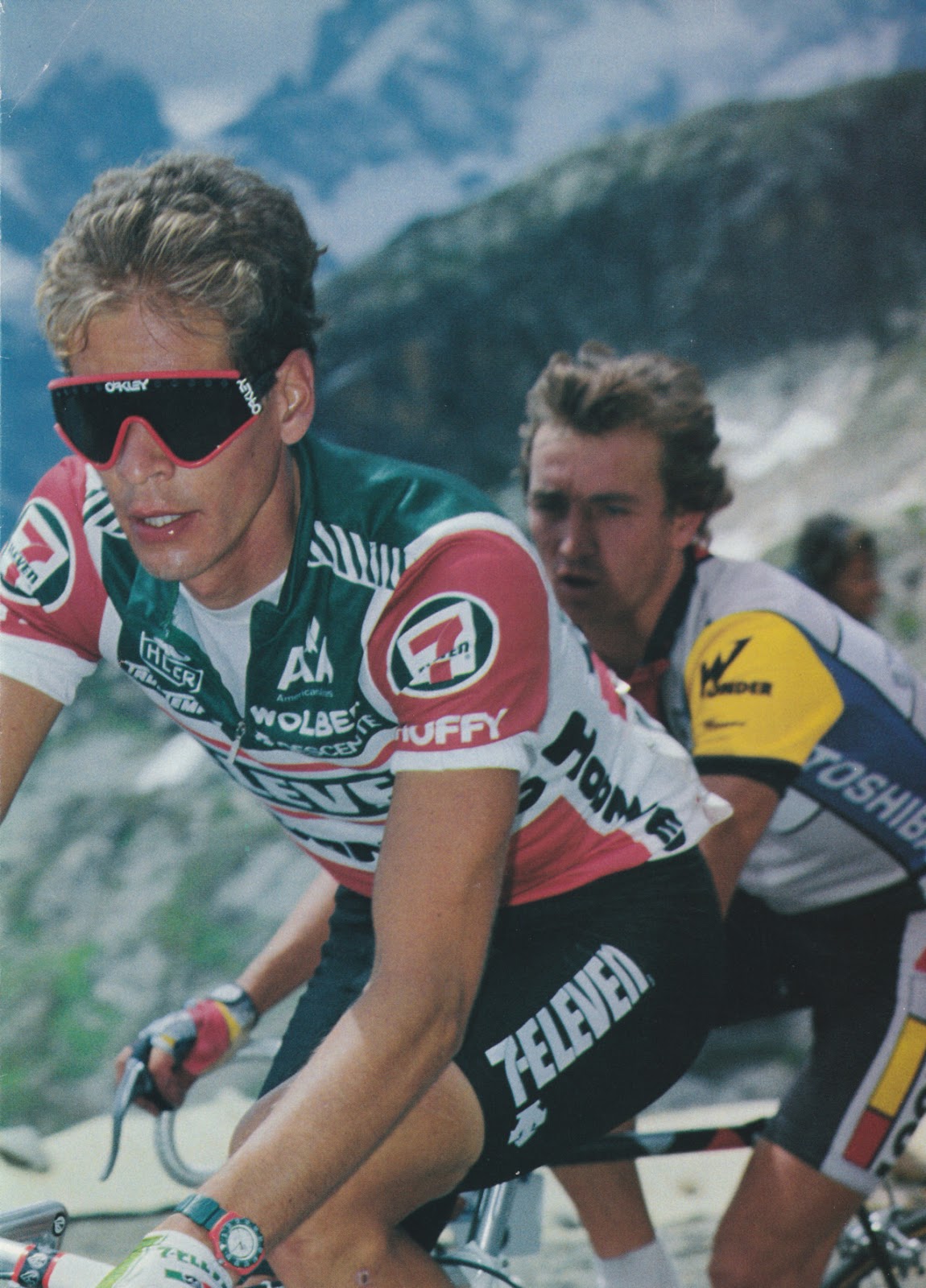
Andy Hampsten and the 7-ELEVEN team were my cycling idols in the 80s.

And he was the first American winner of the Giro D'Italia back in 1988.

Courtesy, clearly, of someone else!

And the Tag Heuer connection to cycling (and my passion) went even further and was clearly shared by others, including one of the main voices of Tour de France television coverage today (at least here in the US) Bob Roll, a team mate of Hampsten's on team 7-ELEVEN.
Bob Roll on the left, Andy Hampsten on the right
Bob, or "Bobke" as he is often known is perhaps my all-time favorite cyclist.  Not because of his many wins in big-time races... let's face it, there weren't many! 

Shamelessly borrowed
But Bob, Andy and the rest of the 7-ELEVEN team perhaps best embodied what Tag-Heur's motto is today - they did NOT "Crack under pressure".  No matter what the odds, Bobke put it all out there!
Courtesy of, clearly, someone else
Apart from Hampsten, and Davis Phinney, they were a team made up of journeymen dreamers.  Riders who had a sort of, "what the Hell, let's give it a go" attitude.  Keep in mind, this was the era of a certain fellow known as "the Badger" and a host of other cycling GODs.  But these guys threw their hats in the ring and gave it a go.  And in an age where US cyclists were viewed more as amateurs, they came to Europe and impressed the Europeans.

I got to meet one of my heroes in person when I was working for DOXA Watches and we presented him with a  Yellow DOXA Divingstar in San Francisco -


My identification with Tag Heuer went beyond just the 7-ELEVEN connection.  It was clearly a great brand with a great watch, but like team 7-ELEVEN people didn't just take that at face value.  Tag Heuer had to put in a lot of time and effort to get where they are today.

So as we wait to hear how much the Cara Delevingne auction brings in, I thought it might be fun to think back to some other "underdogs" that Tag Heuer partnered with, back in the 80's.

Enjoy your watches!