Showing posts with label Glasgow. Show all posts

Thursday, December 3, 2020

Extra Time with the Paulin Neo B

Okay, so I grabbed the Paulin New B back while Wendy's back was turned earlier this week and can now "put a bow on this one".


In terms of performance, this is a solid time machine. The finish of the case, crown and buckle are smooth and pleasant not just to look at, but gentle to the touch.
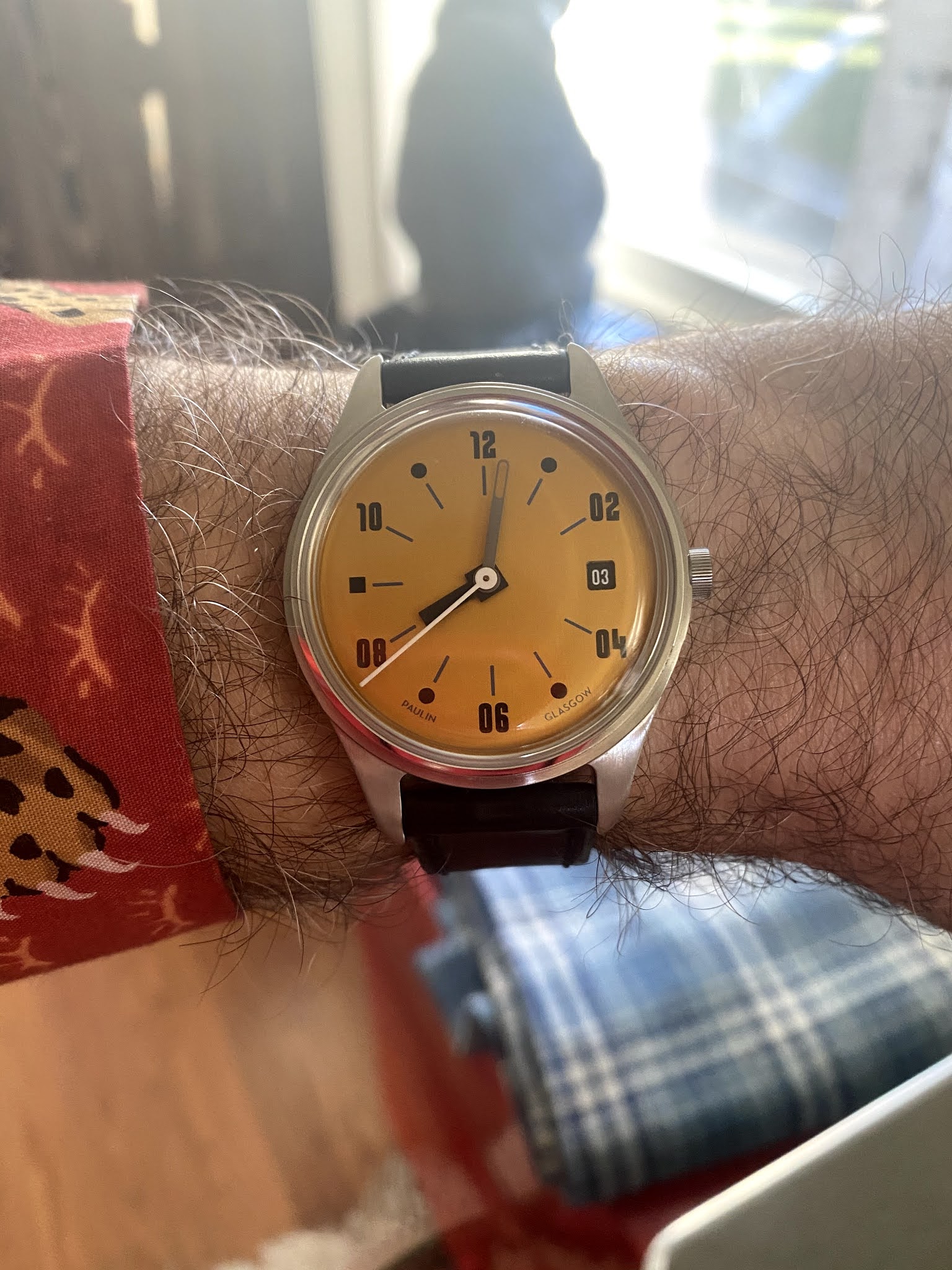

While the hands might not be a universally appealing feature, I dig 'em. I am a real fan of the font, and the subtle (yet noticeable) interplay of color (or as they might say - colour). Is the dial finish work perfect? Well as the upper part of the date window will tell you, no, not perfect.

But in truth, you would have to get down to ridiculous levels of fussiness to be bothered by it. It is something 99% of the folks buying or seeing the watch in normal, everyday life will never notice, and something that I would like to think only .05% would be bothered by.
Are you a BIG watch fan (that referring to the size of the watch vs. the size of your passion)? If so, you will find this too small. Go buy yourself a big diver and get it over with ; )

One last thing in terms of performance - I managed to drop my Neo B from a height of approximately 4 feet (metric fans, you'll have to do your own conversion) and it landed smack on the crystal. And my whole life flashed before my eyes and I was transported back to those not-so-happy days of childhood where I would manage to break or damage just about any nice thing I had. But as fortune would have it, not a mark on the crystal, and I am assuming (happily) that no damage was done, as this was nearly a week ago and it has kept perfect time since then.

My only two complaints -
  1. The crown absolutely sucks. I am sorry, but I have to be honest here. I appreciate the desire to keep to certain aesthetic standard, but it is way too small and not terribly tactile. 
  2. The use of universal "double digits" on the date wheel. I realize that younger eyes might do better with it, but it is actually a bit challenging when you see 02 in such a small space. I also suspect that it is something you get used to over time.


My big - I LOVE YOU points?
  1. The color! Enough said.
  2. The watch face itself - I absolutely love the interplay of the numbers and indices, as well as the subtle, yet pleasantly noticeable use of different colors.
  3. The hands - just quirky enough.
  4. The size - this one is definitely a Goldilocks size watch - "Just Right".
  5. Price - More than fair, even for those who have to stump up the VAT.
Now as a reminder, I am not writing this review as someone who was sent a sample, but rather someone who dug into their wallet and paid their own money to buy this. At £395.00 - that's $532 in US funds, it is a fair price for a fun mechanical watch. And the price for those of us outside of the European zone is even better once the VAT is removed. I did opt for a strap upgrade and will say that the cordovan strap which represented a slightly higher price was well worth the extra cost.

As I had mentioned, I immediately fell in love with the Neo B at first sight. It was as if someone grabbed that SWATCH Yamaha Racer that I had missed out on as Northern Youth and built it into a grown-up watch. And that love is still strong after the past month or so. There were a few things that were disappointing, and those would really connect to the human-touch points:

  • The communication from Paulin was simply not good. Now the one argument you could make is: "Hey, don't know if you noticed, but we're in the middle of a pandemic, pal!" And were I going into a High Street shop I would absolutely agree with you. But the truth of the matter is that when you are a web-based business, you have to communicate a bit better.
  • Order fulfillment and receipt - I am again of 2 minds here. On the one hand, I did get my watch in the end. On the other hand, I had to reach out to Paulin more than once to find out if/when the watch was going to ship as the "start ship" date had already come and gone with no information from Glasgow in my in-box. I never got a definitive answer, more of a "it will probably ship..."
  • Priority of "who got what when" - As I was waiting to hear if/when my watch would ship as the ship date start had passed with no word, I saw a review from Robert-Jan at Fratello Watches on, you guessed it, the Paulin Neo B. And to be clear, this irritated me. Not as someone who writes about watches and potential reviewer, but rather as a customer. On a side note, I have a lot of respect for Robert-Jan and I don't begrudge him Paulin's decision making paradigm. But as a customer who was receiving no information from the brand about his purchase, this took a little bloom off of the bud.
So probably the only question that really matters - "Would you buy this watch again?"

Hell's Yes! 
This watch is, to quote the young boys and girls camping out overnight to buy the latest Nike drop at Bodega -
"Sooooo Drip!"  (that's good).
Per the Urban Dictionary -
adjective to describe your outfit similar to swag, sauce, steez, swank
dripmane - "mane my outfit is dripping right now"

friend - "your outfit wet asf"
via giphy
by splashtonkutcher October 08, 2018

And apparently I am not the only one, it seems that the second run has already sold out as well!  Should you be ready to put your marker down, here are the pertinents -

Movement: 
Seiko NH35A (Automatic)

Lens: 
Hesalite box section PVC

Water resistance: 
5ATM

Case: 
316L stainless steel

Case diameter: 
38mm

Case thickness: 
11.6mm

Strap width: 
18mm

Warranty: 
24 months

Saturday, October 24, 2020

Something To Look Forward To

Like probably every single person out there suffering from insomnia and therefore reading Tempus Fugit, I am tired.  Like you, I am tired of COVID and the startling way it has somehow become a political issue. Let's hope we all live through it. 

I was thinking about something that I said at the second annual (and final) gathering of the "Watch Expert's Network" at BaselWorld (the less said about that ill-fated effort, the better), where I asked the absolutely crazy question - "Do any of you actually remember why you got involved in writing about watches in the first place?"  Well, imagine a vacuum sucking all of the air out of the room at a startling rate.  More than a few feathers were ruffled, but Robert-Jan Broer, to his credit, understood that I wasn't trying to pick a fight with anyone, but I was a wee bit exasperated by the waste of an hour and a half listening to a lot of hot air during Sunday (the busiest day at BaselWorld back then).  But to Robert-Jan's credit, he understood what I was driving at - "What was the trigger."  In other words, what drove us all to be interested in something like watches in the first place?

Well, I remember my first SWATCH, the Calypso Diver. I could go into all sorts of crazy details, recount the story, but essentially I hopped into my 1978 Toyota Corona and drove to Midway Mall.  There in the May Company's jewelry case they had the Calypso Diver and the Yamaha Racer. It was back and forth between the two of them, but in the end I opted for the Calypso Diver.

Anyway, that is a long way of saying that I actually really miss those particular SWATCHs. Last week a reader forwarded me this website -

Paulin Watches

And once there, gentle reader, my eye fell on this time machine -

Courtesy of Paulin Watches

So I selected he black cordovan strap and solid case back option -

Courtesy of Paulin Watches
And I ordered!

As a side note, I do not think that they engrave case backs, but I will do that when it arrives.  I will keep you posted ; )

I am not one for hyperbole - I have not held one, worn one or spoken to anyone who has owned a Paulin Watches watch. But some things you gotta take on faith, and I am ready to place mine here.

For those of you who are curious, here are the pertinents -

Movement: 
Seiko NH35A (Automatic)

Lens: 
Hesalite box section PVC

Water resistance: 
5ATM

Case: 
316L stainless steel

Case diameter: 
38mm

Case thickness: 
11.6mm

Strap width: 
18mm

Warranty: 
24 months

Thursday, September 3, 2020

A Few Minutes With Lewis Heath

A bit of Henki lore -

A long, long time ago I was actual fit (and rumor has it, somewhat handsome) and was fairly proficient with my left foot and a football. A brief flicker of boyhood fantasy was met head-on with reality when actually clapping eyes on the ability (and size) of the Lothian lads who I'd have to prove to be better than. Needless to say, university has proven to be a wiser choice in the end ; )

Years later, Wendy and I were what might be referred to as "summer guests" in the English Teaching Unit at Saint Andrews where students squeezed in some grammar between rounds of golf and lager. We spent four summers there, all of them memorable for different reasons. And while there is much to recommend Saint Andrews, I myself have always been partial to Dundee and Glasgow.

At that time (96 - 99) I was not really into watches. I had a very nice one - a Yellow Omega Speedmaster (one of the first Schumacher models) that I paid for with summer earnings from tutoring a large group of kids from an oil-wealthy nation five afternoons a week. And it is probably just as well that anOrdain was not "in the game" at that time, as all of my summer earnings might have found their way to Glasgow.

anOrdain is not an old brand, but as with many things, quality and originality find a way of making themselves known.

And now, a few minutes with Lewis Heath -
Courtesy of AnOrdain

James Henderson - What was your first watch? Was it a gift? Is there a story behind it?

Lewis Heath - The first one I remember was a small Russian propaganda watch with an astronaut on the dial. It was kitschy and quirky and very East-Berlin circa the early noughties - a place which my student-self was besotted with! It was, naturally, purchased in a flea market and although it never worked particularly well, does bring back memories of kebabs and pubs which never shut.


JH - When you were a kid, what did you want to be when you grew up?

LH - I remember thinking I was going to end up as a poet for some reason - perhaps this was my 10 year old self managing expectations and, realising even then how terrible I was at singing, creating a more feasible aspiration than the normal Rock Star one.


JH - Where did you go to school? What did you study?

LH - Architecture in Edinburgh’s art college. In all honesty I shouldn’t have got in, or (successfully passed) out really. I was a complete daydreamer at school and my exam results were awful. The admissions tutor took pity on me and let me in, but I wasn’t built for academia. It only took me 26 years to realise that..


JH - What did you do before launching anOrdain?

LH - I started a consumer electronics company - it was actually meant to be a bedroom-run business for a friend of mine who was struggling with some mental health issues, the idea was to give her some sort of purpose to her days. We borrowed money and then shortly after she got sectioned, so I was left with a fledgling audio company aimed squarely at teenage girls with a penchant for Japanese street fashion. At least you couldn’t say we didn’t have a niche! I was working on a building site at the time - it was the closest I could get to architecture - and paying back the money would have taken me years. So I decided to try and make it work. It didn’t, and after a disastrous year or two I restarted it as a mainstream audio company and when I left 5 years later we had 60 odd people and a pretty healthy business.


JH - What drew you to the watch business in the first place?

LH - I’d had this idea that making watches in the Highlands would work, based completely on an un-researched hunch when I was 18 or so, but the idea stuck and I began to think of it as what I was going to do in the long term. My old audio business was all Asian manufacturing, and I loved visiting places like Zhuhai - the food and people were just amazing - but as a designer, working with a factory on the other side of the world, half a day ahead and speaking a different language is frustrating at best. The ‘designers and makers under one roof’ ethos at anOrdain probably stemmed from that.


JH - What was the spark that moved you to create anOrdain?

LH - It was a gradual thing, it’d been on my mind for so long that in the end I just wanted to get on with it. I’m glad I didn’t do it earlier as I’d (hopefully!) got most of my mistakes out the way and had a feel for what a good business to be a part of should be by then.


JH - What have been some of the biggest challenges you have faced?

LH - The very slow, painful ascension from complete horological ignorance!
There are a lot of British based watch companies, but there’s really no industry to speak of, so starting anything here from scratch which involves manufacturing is difficult. I probably have more fingers than there are watchmakers of working age in Scotland - so we were incredibly lucky to find Chris (our watchmaker), he was distance learning through the BHI by evening and working as a picker in an Amazon warehouse by day. The local horological chapter recommended him and he’s brilliant; he’s qualified, won a load of awards and is now training up Euan, our apprentice. But he was the first and only watchmaker we could find, and that took 2 years or so!
Enameling was really the big challenge - it’s done by a few Swiss companies and Grand Seiko in Japan - I doubt if there’s anyone still alive in the UK who was employed doing it, so there was nobody to ask and no books to learn from. Back in 2014 I’d gone to see the Jewellery Dept at Glasgow School of Art to ask if they knew of any graduates who might be interested in a job working out how to make an enamel watch dial. One person got in touch and we rented a small studio for him in January 2015, and that was really the start of anOrdain.

Small to medium sized watch brands generally have a manufacturing partner - normally a Swiss assembled/Chinese parts setup, and those guys deal with the subcontractors - the case maker, hand maker, dial etc. We did look at that route, but decided to deal directly because it gave us more freedom and meant we could get a lot better quality for the same money. But that was also a steep learning curve, and I think the original Model 1 was ever so slightly clunky for that reason.


JH - What have been some of the most unexpected successes?

LH - People liking and actually buying the watches was a big one - I really didn’t know if that was going to happen during those years before launch, so that was a great relief. But for me, and hopefully none of them will read this, it’s the team. When we started there were two of us and we didn’t even know how a dial joined onto a movement. Today there are 11 very talented people - most of whom are under 30 - who have gained a huge amount of knowledge and skill and really take pride in what they do, and quite honestly are, in terms of watchmaking, doing something world-class in a city where you’d otherwise struggle to get the battery in your Swatch changed.


JH - For most "out of towners" Scotland typically means either Edinburgh or the Highlands. I have always been a Dundee and Glasgow fan myself. So a two part question - what should the naysayers know and appreciate about Glasgow? And what motivated you to set up in Glasgow?

LH - There’s an old saying which one of our customers from the US reminded me of lately - “You’ll have more fun at a Glasgow funeral than an Edinburgh wedding”. Edinburgh is beautiful, and Glasgow is friendly - I’ve lived for many years in both and there is a lot of truth in that. Although my evenings are taken up with kids these days, Glasgow has the best nightlife and music scene in Scotland, and there’s a thriving creative community - due in part to the great art school here.


JH - What is your biggest market for anOrdain?

LH - The US of A.


JH - What is "right" in the watch business? What needs to change?

LH - I’m a great fan of interesting, off-beat indies like Fiona Kruger (her chaos series is the most underrated piece of horological design to my eyes), MB&F, I always loved Alain Silberstein, Ochs und Junior - people with imagination and talent and the courage to use it in a watch really.

In terms of change, I’d like to see less duplicity when it comes to ‘Made in’. When I first went to a sourcing fair in Switzerland and saw how little was actually made there it really changed my perspective; it kind of killed the watch consumer in me! Seeing a £10k watch from a respectable Swiss brand whose only real selling point is their hand-made Swissness - a watch which the week before I’d have been excited to see in a boutique back home - actually has a dial made in Thailand, Indian hands and a Chinese strap and case just completely disillusions you. I’m very passionate about what we do and what a lot of other indies are doing, but these days when I’m on a watch website I find myself skipping articles on 80% of brands.


JH - If you weren't doing this, what do you think you might be doing?

LH - Lately I’ve been spending a lot of time trying - with mixed success - to make saucisson in a big oak chamber I built in my study. The smell of decomposing meat is never far away in this house - I have a very tolerant wife. Hopefully people continue to wear watches though and I don’t need to turn pro.


JH - What advice do you have for the next AnOrdain out there?

LH - There are some people in the industry who manage to put out a great product single-handedly - I’m always impressed whether it be Autodromo, Halios or Fiona Kruger. But if you’re anything like me the important thing is to be really self-critical, realise you’re mediocre at best when it comes to probably everything which needs to be done in the business, and make your priority finding people who are really very good at what they do.


Friday, November 2, 2018

Gaun Yersel!

Another little known piece of Henki lore, I spent four summers teaching English at St Andrews University.  And while it was my responsibility to impart the more standardized aspects of the English language, I often found myself the language student as I walked the streets of Dundee, Edinburgh, and particularly Glasgow!  

"Ya ken?" 
Translation:
"Ya feel me?"

At any rate, the weekends were always magical, and had Anordain been around back then, half of my pay-packet would have gone for this little bijoux -

Courtesy of Anordain

This is the Model 1 in Post Office Red, and it is, gentle reader, THE SHIT THAT KILLED ELVIS!  When you have worked in the industry as long as I have, and you get to wear, touch and hold pretty much anything you want (granted, you have to give it back), it takes something special to get your attention.  You start to get to the same level of working at the Chipper (fish and chips shop), and the absolute last thing you will want in your off hours is fish and chips.  

This watch sends me, it hits the visceral button that strips away pretty much every other argument about movement, size, brand history, etc.  This is special.

And that's me away!

Here are the pertinents, straight from the source -

Detailed specifications:

Case diameter
38mm

Lug to lug length
45mm

Case depth
12.3mm

Strap width
18mm

Dial
vitreous enamel on copper

Movement
Sellita SW200-1 with Incabloc

Case
38mm diameter, 5 ATM, exhibition back Stainless steel, polished, hardened to 800 Vickers.

Sapphire
double dome with 6 layers of anti-reflective coating

Hands
made by Estima to our design

Straps
Italian shell cordovan or hypoallergenic suede, German made

Wednesday, July 15, 2015

Rolex Laureate - Karina Atkinson

Courtesy of Rolex
Karina Atkinson Rolex Laureate in 2012 for her project to help create and foster sustainable eco-tourism in Paraguay.  You can find out more about here organization, Paralatierra here:
http://www.paralatierra.org


And here are the details of her project, again courtesy of Rolex:

Nurturing South America’s forgotten corner
Scottish biologist Karina Atkinson is helping to transform a little-known Paraguayan reserve into a model of scientific conservation and sustainable tourism that benefits the local community.

Karina Atkinson is a young woman in a hurry. Determined, within the next five years, to turn her Paraguayan NGO into a conservation model, she has become a trailblazer in an astonishingly short time. Thanks to her, Paraguay, one of the poorest countries in South America, now has its first organization – Para La Tierra – conducting scientific projects all year round in a little-known natural reserve. Scientists and young interns from around the world are travelling thousands of kilometres to benefit from the programme, and the funds from her 2012 Rolex Award are enabling her to expand her vision for her environmental project.

When she set out for Paraguay from her native Scotland in 2008 to take part in a volunteer programme, Atkinson did so with a sense of adventure. No one she knew had visited Paraguay. “I liked the idea of being a pioneer.” But on arrival she quickly understood that she was totally unprepared. The trip from the airport was not pleasant for the 22-year-old. “From the taxi window, I realized I had landed in the third world and I didn’t much like it. The poverty and my inability to understand what anyone was saying frightened me.”

However, over the next few months, she gained confidence as she got to know the culture and the people – whom she describes as “very friendly, but exceptionally shy”. During a break in her volunteer work, she discovered a natural lake, Laguna Blanca, which she had never heard of previously. “From then on, I didn’t want to leave, and cancelled and rebooked my flight three times in order to stay,” Atkinson explains.

Her personal life, even her way of thinking, has been transformed in the past few years. Paraguay is now her home. “Watching the people and how they live their lives was what made me decide I wanted to be in Paraguay. There seemed so much to learn,” she says. She spends 11 months of every year there as she overcomes obstacles in her project, which has the potential to bring major benefits to the nation and the natural environment.

Sound science
Trained in genetics and biology in Glasgow, she has given her project a sound scientific foundation. And she is about to undertake a course of research and study (by distance learning) to gain her Master’s degree in zoology from Miami University in Ohio. But, she points out, Paraguay has taught her things about problem-solving she could not learn from any university. “The solutions to everyday problems here, which are different from those that occur in the Western world, are so simple and logical – it’s this approach to problem-solving that really attracts me about taking on the project in Paraguay,” she explains.

In April 2010, Atkinson co-founded Para La Tierra, an NGO dedicated to the conservation of Reserva Natural Laguna Blanca. The 804-hectare reserve lies at the confluence of three major eco-regions: the Upper Paraná Atlantic Forest, the Cerrado (both globally endangered habitats) and the Bosque Central of Paraguay. The eponymously named Laguna Blanca is an artesian lake and the reserve is home to a wide diversity of plants and wildlife, including a number of rare, threatened and endangered species; 283 species of birds have been recorded to date, including 12 globally endangered and four near-threatened species. The flora and fauna of this nation, sometimes described as “South America´s Forgotten Corner”, have received relatively little attention from scientists up to now.

“It’s like paradise,” Atkinson says of the reserve. “I live near the lake, it’s always sunny and each morning I walk out onto the beach. And there is so much to see. There are three different habitats each with different species on the reserve. You never get bored.”

But there are threats to this paradise and to the country’s wildlife – hence Atkinson’s sense of urgency. She explains that a boom in industrial farming has boosted Paraguay’s economy, but the resulting intensive cattle ranching and soya and eucalyptus cash-cropping are encroaching on the natural environment. And, she also adds pointedly, these economic developments have done little to improve the lives of people who live near the reserve.

Under Atkinson’s leadership, Para La Tierra, with three full-time and two part-time staff, is coming to the rescue of the reserve and nearby residents through a combination of scientific research and community outreach. Atkinson and her colleagues are providing the scientific basis for the conservation of the numerous globally threatened species and habitats at the reserve, establishing a collection of local species that has already become a reference for scientists in Paraguay and further afield.

Since its creation, the organization has welcomed more than 150 temporary volunteers and professional scientists, carrying out a total of 29 distinct research projects. Ten articles have been published in scientific journals, with a further 12 in preparation. As well as the initial research station she founded at Laguna Blanca in 2010, Atkinson is now “90 per cent confident” that she will be able to set up another museum in the Paraguayan Chaco. With natural and human history exhibits, it will represent a substantial achievement in the second stage of Atkinson’s project.

Changing local attitudes is perhaps the biggest challenge facing Atkinson and her colleagues. “The adults living in the surrounding communities [near the reserve] initially had no concept of conservation or the value of the habitats near to where they live,” says Atkinson. “All the information we provide in workshops and meetings is new to them, making it difficult for them to believe our words. Some are also angry with us due to the rule changes after the declaration of the reserve in February 2010, prohibiting them from hunting for food and logging for firewood. But in recent months we’ve noticed more local people are coming onto the reserve and more are joining our workshops. These are signs that attitudes are changing, but it’s just the beginning of a long-term process.”

In the long term, ecotourism will bring income to the local community and, for the immediate benefit of residents, Atkinson’s team has built, with part of her Rolex Awards funds, three poultry coops, in villages near the reserve. The coops are providing 300 to 500 chickens every six weeks, ensuring a supply of eggs and poultry for 50 families to consume and sell. The funds from her Award have been extremely useful, Atkinson explains. And the public response to her project, following press coverage in the UK of her Rolex Award, has been “overwhelming”, with both ordinary citizens and people with projects contacting her to ask how they can get involved.

Asked at what point in its development her ambitious project now stands, Atkinson laughs good-naturedly. “Oh, I’m still at the beginning. I need to expand it so that there’s a network of Para La Tierras. To tell you the truth, I don’t think I’ll ever be able to say it’s finished. I want to do so much. But the Rolex Award has definitely been a springboard to make things happen.”

Edmund Doogue